slide 1 of 1
Max. Elevation
4130 m / 13549 ft
Group size
Max 10(Single Supplementary US$.175)
Level
Moderate
Transportation
Sharing Jeep/Bus 
Best Season
Sept, Oct, Nov, December, February, March, April, May,Jun
Starts at / Ends at
Pokhara / Pokhara
Accomodation
Tourist Standard Hotel in Pokhara and Best Available Lodge in the mountain 
Meals
Breakfast 
Trip Route
Pokhara-Jhinu Danda-Chhomrong-Sinuwa-Deurali-ABC-Sinuwa- Jhinu Danda- Pokhara

Highlights

  • Enjoy this cheaper, more accessible and more flexible Annapurna Base Camp Trek from Pokhara
  • Budget Friendly and Precise ABC Trek from Pokhara
  • Shorter Time frame than beginning from Kathmandu
  • Have plenty of time to explore Pokhara and its  incredible premises
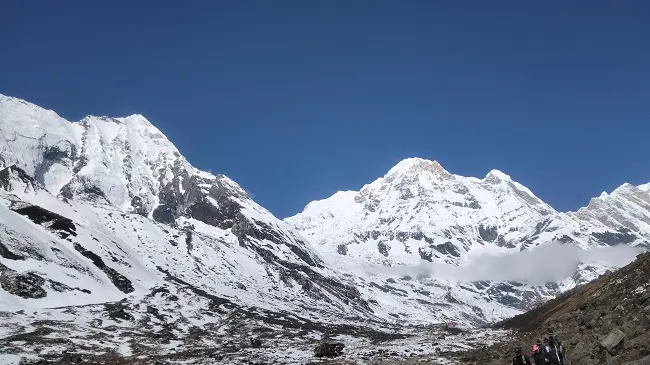
  • Witness Annapurna I (8,091 m), the 10th highest mountain in the world.
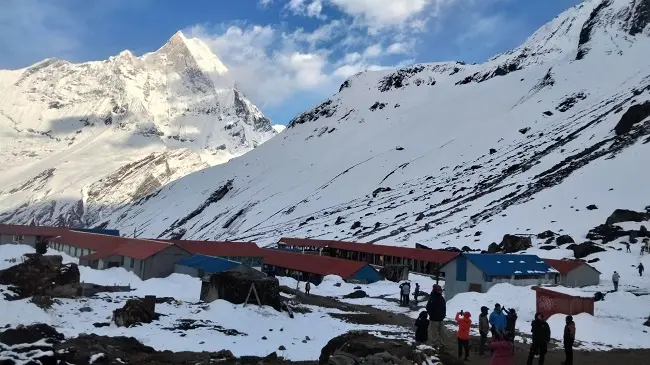
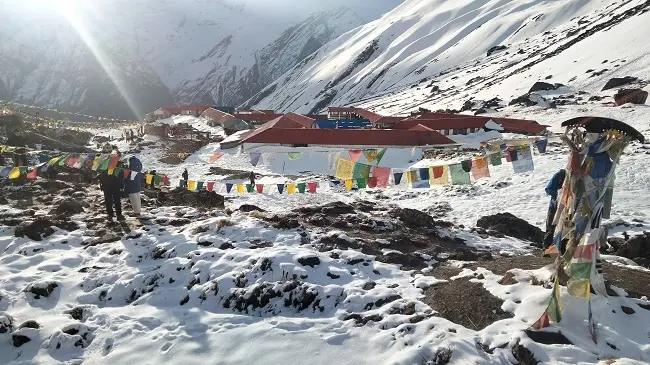
  • Reach Annapurna Base Camp at 4,130 m for a panoramic Himalayan view.
  • Trek through Machapuchare Base Camp at 3,700 m beneath the sacred Fishtail Peak (6,993 m).
  • Visit Chhomrong village at 2,170 m with stunning views of Annapurna South (7,219 m) and Hiunchuli (6,441 m).
  • Travel through lush bamboo and rhododendron forests at 2,300 m to 3,000 m.
  • Overnight at Jhinu Danda at 1,780 m with natural hot springs on the Modi Khola.
  • Explore Pokhara city with Davis Fall, Caves, Fewa Lake, World Peace Stupa and Pumdikot Shiva

Overview

Annapurna Base Camp Trek Description

The Annapurna Base Camp (ABC) Trek from Pokhara begins with a scenic jeep drive from Pokhara (2,713 ft / 827 m) to Jhinu Danda (5,741 ft / 1,750 m), a distance of 55 km in 3–4 hours. The trek loop begins and ends at Jhinu Danda and is a favourite among time-strapped travelers. The total treking distance of Jhinu Danda to Annapurna Base Camp (13,550 ft / 4,130 m) and back is about 63 km (39 miles). Including the drive from Pokhara to Jhinu Danda and back, the Pokhara to Pokhara distance for ABC Trek is about 173 km.

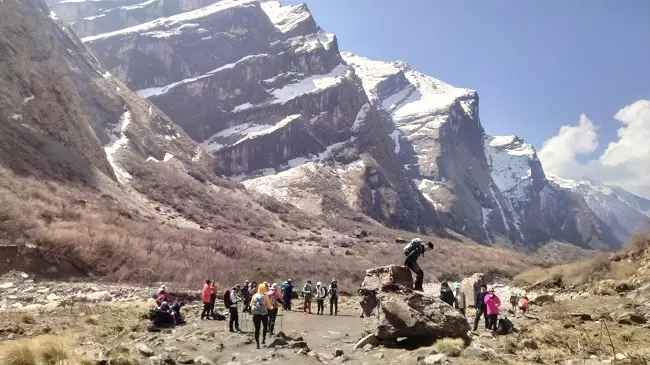
Trekking to Annapurna Base Camp from Pokhara offers breathtaking views of Annapurna I (26,545 ft / 8,091 m), Machapuchare (22,943 ft / 6,993 m), Hiunchuli (21,132 ft / 6,441 m), and Annapurna South (23,684 ft / 7,219 m). The trek passes through forests, stone steps, cultivated fields, rivers, and ancient Gurung villages like Chhomrong (7,120 ft / 2,170 m), Dovan (8,530 ft / 2,600 m), and Deurali (10,595 ft / 3,230 m).

The most challenging part of the ABC trail from Pokhara is from Deurali to Machapuchare Base Camp (12,135 ft / 3,700 m), where the trail gets steeper and more subject to avalanche-risk areas. The trail conditions range from stone-paved roads to small dirt paths. The difficulty of Annapurna Base Camp from Pokhara is moderate to demanding, mainly due to altitude gain and extended hours of walking daily.

Trekkers generally trek 10–15 km a day for which they spend 5–7 hours of trekking each day in ABC from Pokhara. The whole trekking time from Jhinu Danda to ABC and back is 5 to 7 days depending on speed. Keeping the time taken for traveling from Pokhara in mind, the whole tour takes 7 to 9 days. The maximum altitude reached during Annapurna Base Camp Trekking from Pokhara is 13,550 ft (4,130 m) at Annapurna Base Camp.

Basic teahouses offer hot meals and clean rooms with twin beds during your Annapurna Base Camp Trek from Pokhara. Dal Bhat, noodles, soups, and pancakes are staples. Electricity and internet access in most villages are available, sometimes for a supplement.

The best season for the Annapurna Trek from Pokhara is spring (March–May) and autumn (September–November) for blue skies, spectacular mountain views, flowering rhododendron and good weather.

Permits needed for ABC Trekking from Pokhara include the ACAP (Annapurna Conservation Area Permit) and TIMS (Trekkers' Information Management System). A guide is not mandatory; porters are optional but highly recommended for a comfortable trek.

Why Annapurna Base Camp Trek from Pokhara?

Annapurna Base Camp (ABC) Trek from Pokhara is a convenient and popular choice for trekkers. Pokhara, being at 822 meters, is the ideal place to begin due to its close proximity to the trailhead and ease in logistics. Starting  ABC Trek from Pokhara saves time, money, and trouble as opposed to Kathmandu (1,400 meters). The trekking trail offers scenic views, diverse ethnic villages, and stunning views of Annapurna I (8,091 m), Machapuchare (6,993 m), and Hiunchuli (6,441 m). Pokhara-based trekking means more time on the trail and less in transit and is therefore the better option for both novice and experienced trekkers.

1. Less Time and Money to Get to the Trailhead
Starting the Annapurna Base Camp trek from Pokhara is time and money saving compared to Kathmandu.

You must fly (30 minutes, USD 100–130 one way) or drive (6–8 hours, USD 10–20) from Kathmandu to Pokhara before reaching the trailhead in Nayapul (1,070 m). However, you may reach Nayapul by a 1.5-hour jeep or bus ride costing just USD 3–5, having started directly from Pokhara.

This reduces transportation expenses significantly. For example, round-trip airfares from Kathmandu to Pokhara are about USD 250 per person. Pokhara trekking companies also offer lower packages due to local presence.

Thus, starting Annapurna Base Camp from Pokhara minimizes logistics inconvenience, saves budget for other necessities, and adds value.

2. More Trekking, Less Transit
 Beginning your Annapurna Base Camp Trek in Pokhara makes you trek more and travel less.
When you begin in Kathmandu, the trip takes hours of driving on winding mountain roads or waiting around airports. This sets you back in getting to be part of the trek itself.

From Pokhara, you can reach Jhinu Danda (1,780 m) or Chhomrong (2,170 m) on the day you depart. For example, trekkers usually depart from Nayapul (1,070 m), then reach Ghandruk (1,940 m) in the late afternoon.

With Pokhara as your base, a day is spent just reaching Pokhara. Departing from Pokhara maximizes time spent on scenic trails and allows natural adjustment to elevations along the way.

3. Simpler Acclimatization and Steady Elevation Gain
The ABC trail from Pokhara is a steady and secure altitude gain.

You begin ABC trek from Pokhara at 822 meters and go up gradually through villages such as Ghandruk (1,940 m), Chhomrong (2,170 m), Himalaya Hotel (2,920 m), and Deurali (3,200 m), finally arriving at Annapurna Base Camp at 4,130 meters.

This gradual natural ascent helps acclimatize your body and minimizes the risk of altitude sickness.
Unlike hurried travel from Kathmandu, however, which can condense your itinerary into too little time, resulting in huge elevation gain.
A more gradual, Pokhara-based ascent provides better acclimatization. For instance, most trekkers have fewer symptoms on the Pokhara route than on rushed itineraries starting in Kathmandu.

4. Better Local Facilities and Support Services
Pokhara is a trekking hub with reliable local services like trekking equipment, local travel companies, food stores and easy availability of  trekking guides and porter.

You find experienced guides, good quality equipment rentals, and reasonable accommodations in Lakeside Pokhara before your trek.
Pokhara local guides are familiar with the ABC trail and also mostly English-speaking. A Pokhara local guide to ABC will be about USD 25–30/day, while a Kathmandu one will be USD 35+.

The local infrastructure system enables quick coordination, in the event of something going wrong or needing to be altered.
For instance, if weather conditions require alterations, Pokhara agencies can immediately arrange transport, porters, or extra nights.
You enjoy both safety and comfort from the beginning beginning from this well-established city.

5. More Flexible Itineraries and Return Options
Pokhara offers flexibility during Annapurna Base Camp Trek which Kathmandu lacks.
You can adjust trek duration—from 5 to 6 days—according to your time, stamina, and weather.

You may start from Nayapul (1,070 m), if you like a classical ABC Trek, Ghandruk (1,940 m), or even Kimche (1,640 m) by jeep. Return points could be Jhinu Danda's hot springs or a short excursion to Poon Hill (3,210 m).

If you are tired, you can descend to Siwai (1,100 m) or Matque and return to Pokhara the same day.

Trekking from Kathmandu does not permit this since your schedule must incorporate long transfers to and from Pokhara.

You tailor your trip from Pokhara. But Normally, people these days begin their ABC trek from Jhino Danda directly and end at the same point rather trekking via Nayapool and  Siwai.

Why Booking Annapurna Base Camp Trek from Pokhara with Haven Holidays?

1. Local Expert Guides from Annapruna Region
2. Convenient arrangements of transportation, accommodation, trekking permits and meals
3. Reliable Porter to carry your Luggage during trek ABC Trek
4. Wider information about the ABC Trail, local flora and fauna in Annapurna Conservation Area and mountain summits
5. Samrt Risks management during the trek
6. Attentive and personal care of the individual trekker
7. Flexible and Co-Operative Team
8.  Team with Good Communication 
9. Eco –Friendly and Enhancing Sustainability in Tourism
10. Recreational and Lively trekking crew

Annapurna Base Camp Trek from Pokhara: Required Permits and Charges

  • To trek to Annapurna Base Camp (ABC) from Pokhara, two permits are necessary: the Annapurna Conservation Area Permit (ACAP) and the Trekkers' Information Management System (TIMS) card. Both are mandatory for all trekkers entering the Annapurna region.
  • ACAP is NPR 3,000 (around USD 23) for non-South Asian foreign nationals and NPR 1,000 for SAARC nationals.
  • TIMS card costs NPR 2,000 (around USD 15) if on your own, and NPR 1,000 if in company of a registered guide or agent.
  • Either is available at the Nepal Tourism Board office in Pokhara (Damside) or the Nepal Tourism Board (NTB) or TAAN office in Kathmandu. Two passport-sized photos and one photocopy of the passport are sufficient.
  • Best way to acquire the permits is either:
  • Independently, by visiting the permit offices between 10 AM and 5 PM, Sunday to Friday,
  • By using a trekking agency, which simplifies the process and includes the fee in your package.
  • It is recommended that the permits are obtained in Pokhara before starting the trek, as they scan them at checkpoints like Nayapul or Ghandruk.

Annapurna Base Camp Trek from Pokhara: Foods and Accommodation

The Annapurna Base Camp (ABC) Trek offers good quality of food and cozy stay. Hot, fresh meals are prepared every day by most teahouses and lodges during the trek. You can enjoy typical Nepali dal bhat, rice, lentils, vegetables, and pickle. Momo (dumplings), thukpa (noodle soup), fried rice, chapati with curry, and Tibetan bread are some other foods. Porridge, pancakes, toast, eggs, and muesli are usually consumed for breakfast by the trekkers. Several lodges offer pasta, pizza, chow mein, spaghetti, and even apple pie. Hot drinks like tea, coffee, hot lemon, and garlic soup are usual.

Accommodation in Annapurna Base Camp Trek is mainly basic teahouses and lodges along each overnight stay. The accommodations are usually twin-share with wood beds, foam mattresses, pillow, and blanket. En-suite rooms are also offered in private rooms in some of the lodges, mainly at lower elevations. Blankets are given, but taking a sleeping bag is highly recommended. Solar hot showers are also available in most camps at a surcharge. Batteries get charged extra at the higher zones.

Toilets facilities in Annapurna Base Camp Trek vary with elevation and location. At lower elevations, the majority of lodges have western-style flush toilets with running water. Some lodges use squat toilets with flushing water buckets. With higher elevation, facilities are less sophisticated. Dry pit toilets are common above 3,000 meters. The majority of toilets are in separate buildings or at the end of the hall. Take your own toilet paper and hand sanitizer. Although simple, lodges are clean and sanitary. The amenities are simple but adequate for most trekkers.

ABC Trek from Pokhara: Guide and Porter

It is not necessary but strongly recommended that you employ a guide and porter for the Annapurna Base Camp (ABC) Trek. The trek goes up to 4,130 meters at the base camp, and a guide helps with safe passage. Trails become muddled, especially in bad weather or if landslides have occurred. A guide gets you on the correct path and provides valuable cultural and local insights.

Porters take up to 20–25 kg, taking the physical strain off you. This avoids exhaustion and altitude sickness above 3,000 meters, such as at Deurali (3,230 m) and Machapuchare Base Camp (3,700 m). Light trekking keeps your journey safe and enjoyable.

You can hire guides and porters in Pokhara. Most of them employ local agencies that provide licensed and insured staff. Agencies provide logistics and possess the route and terrain knowledge for your staff. Independent hiring can be done in towns like Nayapul or Ghandruk, but it is risky if one does not verify credentials.

Guides assist with accommodation, transportation, meals, permits, and medical checks. Porters support local communities and simplify your trek. While some individual trekkers get by alone, most are improved by help above 3,000 meters. Using both guide and porter offers a safer, more satisfying experience on the ABC Trek.

Can I trek to ABC from Pokhara Solo or Independently? 

Yes, you can trek to Annapurna Base Camp (ABC) from Pokhara on your own and solo. Start by taking a taxi to Hari Chowk from your Hotel, jeep to Nayapul and Jhinu Danda, or Ghandruk or Ulleri and Banthanti if you are trekking to ABC via Poon Hill. Trek on the well-marked trail through villages like Chhomrong, Dovan, and Deurali. Overnight in teahouses on the trail, which offer beds and meals? Carry a map or GPS app like Maps.me.

Most solo or independendt trekkers are able to make it without issues. You set your own pace and itinerary. You greet other trekkers daily. The trail stays crowded during peak season, so you will not be lonely. The majority of the locals speak simple English and help when necessary.

But solitary trekking has risks. You can develop altitude sickness above 2,500 meters. You can get lost in bad weather. Snow and landslides can block the route. Illness or injury can delay rescue if you are alone. Some sections are slippery and steep.

For safety, you can hire a guide or porter. A guide gives you correct directions and culture. A porter carries your luggage and spares you energy. Most guides also act as porters. Hiring one supports the local economy. You can easily get guides in Pokhara or online. Be careful, walk lightly, and enjoy the trek to ABC.

Suggested Blog Posts Related to Annapurna Base Camp Trek

Connectivity in Annapurna Base Camp Trek from Pokhara

Connectivity at the Annapurna Base Camp (ABC) Trek has improved but remains spotty in some sections. Most of the lower villages like Ghandruk, Chhomrong, and Jhinu have a good mobile network. NTC and Ncell have the strongest signals on the trail. The signal becomes weaker the higher you climb. Beyond Bamboo, signals will drop or become erratic.

Wi-Fi is available in most teahouses up to Deurali but at a price. The speed of the connection is slow and erratic, especially during peak hours. In Annapurna Base Camp, Wi-Fi is very rare and sporadic. Don't rely on it for critical communication.

Phone signals are present at lower altitudes but be prepared for call drops at higher elevations. Warn family members in advance about the lack of contact. To have improved connectivity, insert a Nepali SIM card in Pokhara prior to the trek. Use NTC for wider coverage in remote regions.

There is an additional fee at most teahouses for Wi-Fi and charging devices. Pack a power bank as a backup for avoiding the extra fees. Download maps and other travel apps offline prior to leaving Pokhara. Slow data or no data would be the norm in most areas. Use local Wi-Fi sparingly. Appreciate the mountains instead of being constantly online.

Annapurna Base Camp Trek from Pokhara: Facility of Drinking Water and Hot shower 

Annapurna Base Camp (ABC) Trekkers can easily obtain fresh and pure drinking water and hot showers. Most teahouses and lodges along the trek offer them. You can buy bottled water, but it is not cost-effective and not eco-friendly. Bottled water is available at NPR 100 to 400, depending on the altitude.

A better option is to fill up reusable bottles with boiled or filtered water. Most lodges provide safe drinking water for a nominal charge of NPR 50 to 150 per liter. Filtered and purified drinking water is managed by Annapurna Conservation Area Project to all the trekkers who travel in Annapurna region with low cost like Rs. 100-150 per liter. Trekkers can treat tap or stream water from mountains (sweet water) with purification tablets or filters. Keep a bottle handy and treat water yourself if needed.

Hot shower facilities are usual in most teahouses along the ABC route. The showers use gas or solar heating. In the lower villages like Ghandruk, Chhomrong, and Sinuwa, water is always hot. In higher areas like Deurali and ABC, hot showers are erratic.

The cost of a hot shower ranges from NPR 200 to 600 during Annapurna Base camp Trek form Pokhara. It goes up with altitude. Always ask about water temperature before use of the service. Some showers may be just lukewarm or bucket showers in case it rains and it is cloudy.

Wi-Fi is also available in most of the lodges on the Everest Link or other internet connections. It usually costs NPR 200 to 500 for a day. The signal is weak at higher elevations or during bad weather.

For the most part, ABC Trek has good water and shower facilities. Be prepared to pay higher prices as you go higher up like at MBC, Deurali and ABC. Carry purification kits for convenience and safety trek to ABC from Pokhara.

Similar Trips

Annapurna Base Camp Trek from Pokhara Vs Annapurna Base Camp Trek from Kathmandu

Annapurna Base Camp Trek from Pokhara
  • Less costly
  • Shorter in duration
  • More flexible in itinerary
  • Easier access to transportation
  • Less traveling fatigue
  • Suitable for short time
Annapurna Base Camp Trek from Kathmandu
  • More expensive
  • Longer in duration
  • Kathmandu sightseeing included
  • Requires domestic flight or long drive
  • Suitable for international arrivals
  • Suitable for full-package tours

Annapurna Base Camp Trek from Pokhara: Transportation Options

Annapurna Base Camp (ABC) Trek can begin straight from Jhinu Danda (1,780 m) or as an optional start from Ulleri (2,070 m) and Poon Hill (3,210 m) for a longer scenic route.

1. Pokhara to Jhinu Danda (Direct Start)
  • Distance: ~60 km
  • Drive Time: 5–6 hours by jeep (Nayapul, Siwai route)
  • Transport Type: Local/shared/private jeep
  • Cost: NPR 1,000–1,500 (shared), NPR 10,000–12,000 (private jeep)
  • Starting Point: Jeeps leave from Baglung Bus Park, Hari Chowk, or via trekking agencies.
  • Alternative starting point: Jhinu Danda, if you want a shorter ABC trek (5–7 days). There's a rough road to Siwai; then a short hike (~1 hour) to Jhinu.

2. Pokhara to Ulleri/Banthanti (Optional via Poon Hill Route)
  • Elevation (Ulleri): 2,070 m
  • Elevation (Banthanti): 2,210 m
  • Distance: ~55 km
  • Drive Duration: 3–4 hours
  • Cost: NPR 700–1,000 (shared), NPR 7,000–9,000 (private jeep)
  • Route: Pokhara – Nayapul – Hile – Tikhedhunga – Ulleri/Banthanti
  • You can add scenic places like Ghorepani (2,860 m) and Poon Hill (3,210 m) to your trek.
3. Return: Jhinu Danda to Pokhara
  • From Jhinu, short walk (~1 hour) to Siwai or Samrung, then:
  • Jeep/bus to Pokhara: 5–6 hours
  • Cost: NPR 1,000–1,500 (shared), NPR 10,000 (private)
How to Arrange Transport
  • Discuss with local travel agents in Lakeside Pokhara
  • Take jeep from Baglung Bus Park or Hari Chowk for Jhino or Ulleri
  • Pickups may also be arranged by hotels and teahouses

Add On Trips

  • Private Jeep From Pokhara to Jhino Danda: USD 100
  • Pokhara Sightseeing Tour: USD 50
  • Extra Night Accommodation in Pokhara: USD 30
  • Tourist Bus from Pokhara to Kathmandu- USD 15
  • Private Car Jeep from Pokhara to Kathmandu: USD 100
  • Paragliding: USD 90
  • Chitwan Jungle Safari Tour (2 Nights 3 Days): USD 155
  • Annapurna Base Camp Horse Riding from Jhino to Sinuwa: USD 100

Important Note

Trekking Mode:  On best available lodge en-route trekking.

Trekking Grade:  Moderate and Adventurous walks.
Highest Point: At Annapurna Base Camp 4,130 m / 13,550 feet. 
Local culture/religion:  Gurung tribes follow Buddhism and Hinduism religions and cultures.
Trekking duration:  04 Nights and 05 Days with a short jeep/bus drive both ways.
Total Trip in Nepal:  05 Nights and 06 Days from arrival to departure.
Popular destinations to explore: Pokhara, Jhino Danda (Hot Spring), Himalaya, Machhapuchhre Base Camp and Annapurna Base Camp 

Best Seasons for Annapurna Base Camp Trek

Annapurna Base Camp Trek, visitors can enjoy walks nearly all seasons of the year except in peak of the summer (August) and peak of winter (January). However, the best seasons are spring and autumn/fall, the peak time for Trekking in Nepal.

Springtime begins from March to May when wildflowers are in seasonal bloom. The day is much longer full of sunshine, and can get cloudy in the afternoon sometimes. Chances of light rain on treks sometimes.

The next best time is autumn/fall, days are mostly clear with enough sunshine, spectacular views and pleasant temperatures for walks.
You have to know some more details Weather in Nepal an overview of the weather in Nepal across different seasons.  

High Altitude Sickness

High altitude sickness is a condition that can occur when our body not adapting well to having less atmospheric pressure and oxygen at high altitudes. Low atmospheric pressure and thin air at high altitudes have effects on the human body and develop altitude illness. 
Some essential High Altitude Sickness information is most important to be aware of the risks and take appropriate precautions to ensure a safe and enjoyable journey.

Things to know before deciding a trip in Nepal

People type and search things to know before deciding a trip in Nepal on Google and other social media platforms and find a number posts about the topic. Though you are fed a number of information about things you should before deciding a trip to Nepal, you have to be very selective to the authentic ones. If you go haphazardly through article and the information, you may be misled while Traveling in Nepal Keep your self calm and cool with more patience while traveling across Nepal either in the cities or in the mountains. 

Various things are must know things before deciding a trip to Nepal but a few things are much more important things to know before departing from your country. There are 5 must know things before deciding a trip to Nepal. They are:  Weather Condition, Geography and Culture, Currency, Food and Accommodation and Health and Securities. let’s know these 5 Must Know Things about Nepal before deciding a vacation trip in Nepal.

Nepal Travel Info

A small landlocked country situated between China and India, covering 0.03% of the whole continent, is Nepal. Also known as the land of the Himalayas, Nepal is a treasure cove for adventure activities. Eight of the fourteen highest mountains above the height of 8000m lie here. Trekkers are bound to come across countless forests, gushing rivers, turquoise lakes, and sparkling glaciers on the trekking routes. It ensures you have the right gear and know how to handle potential  challenges like cultural sensitivity, logistics, health and safety. Knowing Nepal Travel info about the weather conditions, altitude, and terrain helps in preparing adequately for the trek. 

Tips to Make Day-Trek or Day-Tour Productive

Many people may not know the tips to make a trekking or tour day productive and they waste their valuable time haphazardly with chaotic schedule. Yes, you are on the vacation and you must make each second, each minute, each hour and each day very fruitful and highly productive. Otherwise, you will just wander aimlessly with a big mess and ultimately, you will spoil your entire trip. Visit us at 30 Tips to make Day-Trek or Day-Tour Productive and turn your special vacation day a memorable and very fruitful. 

TRIP ITINERARY

Pokhara – Beginning Elevation: 822 m

Jhinu Danda – Drive to: 1,700 m

Sinuwa – Trek to: 2,360 m

Total Trekking Distance: ~7.5 km

Trekking Duration: 4–5 hours

Begin the adventure with an early jeep ride from Pokhara to Jhinu Danda. The 4–5-hour journey is on a bumpy road. The drive passes through Nayapul, Birethanti, and New Bridge, ascending gradually with views of green hills and river valleys.

Beginning at Jhinu Danda, the trek crosses a long suspension bridge over Modi Khola. The trail ascends steeply over terraced fields and dense forest. You pass through the small village of Chhomrong (2,170 m), which offers a great view of Annapurna South (7,219 m) and Hiunchuli (6,441 m).

After a short break, descend via stone stairs to the river Chhomrong Khola. Cross a second bridge and ascend through bamboo and rhododendron trees. The route gets narrower with periodic stone staircases and ends at Sinuwa, secluded in the forest.

Forest zone is occupied by langurs, Himalayan bird species, and butterflies. Enjoy the peaceful atmosphere of the jungle. Sinuwa has very primitive teahouses, with simple but good infrastructure and hot meal.

MAX. ALTITUDE

2,360m / 7,743 ft.

ACCOMMODATION

Lodge

MEALS

Breakfast
Not satisfied with this itinerary? Make your own.
Plan My Trip
Elevation Chart

INCLUDES

  • One night hotel Accommodation on tourist standard with sharing bases in Pokhara.
  • Mountain accommodation and best available Lodge/Guesthouse with Breakfast.
  • Sharing Jeep or bus service Pokhara -Jhinu Danda-Pokhara.
  • Service of guide, who can speak English and explaining about all. 
  • Wages, meals, medical allowance of guide and porters.
  • Necessary Trekking Permits TIMS and ACAP.
  • Comprehensive Medicines carried by our staff if required for minor wounds and sickness.

DOESN'T INCLUDE

  • Nepal Visa, Personal Medical & Travel Insurance.
  • Expenses of a personal nature.
  • Gratitude or tipping for Guide and Porter.
  • Emergency Evacuation if required by any means of quick transportation,
  • Early return from the trek due to personal domestic or medical reasons, no refund will be entertained on breaking the journey.
  • Domestic tickets fare like Kathmandu - Pokhara and Pokhara - Kathmandu. 
  • Kathmandu and Pokhara sightseeing

TRIP INFO

Booking  Terms and Conditions

Booking

To book this trip, you have to find the book now button and click it. After that, you will see a form where you will fill up all the required information for the trip including departure date you want and click the button submit. Now you have successfully completed the form and we will reply your email promptly.

Deposit for Booking

One needs to transfer or deposit 25% amount of the total cost of the trip to book this Annapurna Base Camp Trek 8 days. For example, if the trip you are booking costs USD 1250, the 25% percent for the booking of this trip will be USD 150. Once you have made the advance payment, you need to inform our team for the confirmation of the trip.

Cancellation and Refund,

You can cancel the trip if you want, but no advance payment will be returned to you. It means, no refund will be transferred to your account again for the cancellation of the trip. Actually, once you book the trip, our team needs to prepare the transportation; accommodation and the trip crew for your trip and the company will already make certain payment to other operating sections. Therefore, the other operating department like transportation, food and accommodation, trekking crews are not ready to return the advance payment to us. This is the reason we are not going to return you back the advance payment. But, you can postpone the trip for future. We will offer you the same or other equivalent trip whenever you want in the future.

Trip Postponement and Transfer

Though you cannot get the refund after you cancel your planned trip, you can postpone it for future and you can do whenever you have favorable time for you. Or, you can transfer the same trip to your family members, friends and relatives. If you want you other people who are closer to you do this trip, you can do transfer of offer this trip as a gift. But for this, we require valid and reliable evidence like email address, other contacts and all requires contracts we made previously.

You reserve Annapurna Base Camp Trek for your nearer and dearer ones if you want and can be postponed for future use. Your postponed and transferred trip will be safe and can use  find charging devices that fit your mobile phone. So, keep the focus on your charger with multiple adapters
  • Power Bank: Charging your devices is not possible everywhere. So, it is recommended to carry a power bank for backup

Trekking Packing/Checklist List

When preparing for a trekking trip in Nepal,  it's essential to have the right equipment and packing list to ensure your safety and comfort to complete your mission. You will need to pack smart and light. This packing list doesn’t mean you need to pack everything listed here. This list is a guideline, and your final list will depend on your preferences and judgment as well as your tour destination and season. Follow as per your personal needs and preferences by taking this as a reference. Here’s a comprehensive list of items you should consider:

Trekking Clothing

Headwear:

  • Sun Hat/Cap for sun protection: A Sun hat protects the face from the strong rays of the sun. Carry a lightweight hat that can be easily packed. Or A wide-brimmed hat to cover your ears, neck, and face from the strong rays of the sun. 
  • Thermal hat for warmth: You will need a warm fleece or woolen hat to keep you warm in cold temperatures, especially during freezing nights and cold Himalayan mornings.
  • Buff: At high altitudes, the air is dry and cold. A buff is an essential piece of gear to keep your neck warm and cover your mouth. It will help in protecting you against dryness as well as dust. It protects you from coughing and damaging your throat and lungs.

Body Wear:

  • Short Polypropylene sleeve shirts: Moisture-wicking fabric, Lightweight and good for hiking at lower elevations. Nylon or synthetic fabrics are the best.
  • Long Sleeve Shirts: Moisture-wicking fabric, long-sleeved shirts for higher elevation. Breathable, and fabric shirts will be best. Avoid cotton shirts. We recommend Merino wool or synthetic fabrics.
  • Lightweight Thermal Tops:  To keep your body warm and protect from the deep cold of the mountain. Fleece and wind stopper jacket or pullover.

Pants/Trousers

  • Hiking Pants: We recommend bringing one or two pairs of trekking pants that are quick-drying and made of synthetic material. The type that can be zipped off into shorts can be helpful. You will need to have one waterproof pants that can be worn over your trekking pants in case of rain/heavy snow. 
  • Fleece Pant: When you arrive at your camp (lodge), you will want to change into a fresh pair of clothing. We recommend a pair of warm fleece pants or tracksuit pants.
  • Thermal Trousers: We recommend Moisture-wicking fabric with the use of Merino wool base layers. They can be used for sleeping in, night climbing, and the first layer in keeping your body warm and keeping cold conditions at high altitudes during the day.
  • Fleece or Woolen Pants: We recommend Merino Wool base layers or a synthetic material that will work as well. You will want one pair of warm bottoms to wear under your trekking pants on cold days.
  • Undergarments: Plenty of comfortable undergarments as per gender Moisture-wicking fabric 

Down Jacket (Puffer Jacket)

A down jacket is a versatile and warm piece of clothing that is commonly used in trekking and is most effective when used as a mid-layer or outer layer in cold weather. Consider the layering system and pack other appropriate layers such as base layers, fleece jackets, or a waterproof shell to adjust to changing conditions. Remember to choose a down jacket that fits you well and allows for easy movement. Prioritize your comfort, warmth, and safety when selecting a down jacket for your trekking adventure.

Waterproof Outer Shell Jacket 

You need waterproof and breathable Gore-Tex or similar waterproofing material as an outerwear jacket. This should be lightweight with a hood that will help protect you from rain/snow and help block the wind. 

Hand-wear

  • Light Gloves: You feel comfortable with a thin liner glove for lower temperatures or to wear inside your thick outer gloves for extreme temps. having liner gloves helps to keep your hands warm at all times.
  • Warm Gloves (waterproof recommended): Gloves are an essential item to consider when packing for trekking, especially in colder climates or high-altitude treks At high altitudes and in cold weather conditions, Keeping your hands warm is also vital in making sure you have a comfortable adventure and preventing frostbites

Ensure you choose gloves that fit well and allow for comfortable movement. Gloves that are too tight may restrict circulation, while those that are too loose may not provide sufficient warmth. Consider trying on different sizes and styles to find the right fit for your hands. It's often a good idea to pack an extra pair of gloves in case of unexpected circumstances, such as getting wet or losing a glove.

Footwear   

  • Hiking boots, spare laces, warm, waterproof, ankle support: Choosing and appropriate footwear is crucial for trekking, as it directly impacts your comfort, safety, overall trekking experience. Boots with higher ankle height provide better stability and protection on uneven terrain. Boots with a waterproof or water-resistant membrane to keep your feet dry in wet conditions. Look for boots with breathable materials to prevent excessive sweating and promote comfort. When choosing your trekking footwear, it's essential to consider the terrain, weather conditions, duration of the trek, and personal preference. Ensure that you break in your new footwear before the trek to avoid discomfort or blisters during your journey.
  • Hiking Shoes: Trail Runners shoes for shorter treks on well-established trails in milder conditions, trail running shoes can be a viable option. They offer a lightweight and agile design but may provide less ankle support and protection compared to boots or hiking shoes.
  • Camp Shoes: Camp shoes worn around camp after a day of trekking. The primary purpose of camp shoes is to give your feet a break from the rigors of trekking boots or shoes.    They provide comfort and allow your feet to breathe while you relax at camp
  • Socks: Your footwear with moisture-wicking and comfortable hiking socks made of wool or synthetic materials. Avoid cotton socks, as they tend to retain moisture and can lead to blisters. You need plenty of thin liners and thick socks you have less chance for laundry while in the mountains. 
  • Gaiters : (Optional but helpful in muddy or snowy conditions) These are optional and only required during winter and rainy seasons. These can stop scree/mud/snow from getting into your boots.

Sunglasses or Goggles 

You will need a dark, wrap-around pair of sunglasses, to protect against harsh UV rays and ice glare at higher altitudes. We recommend you carry a spare pair as well.     
prescribe glass user, carry a spare as well.

Backpack With Waterproof Cover 

When selecting a trekking backpack, it's essential to consider its size, features, comfort, and durability. 
Trekking backpacks come in various sizes, typically measured in liters. The ideal size depends on the amount of gear you need to carry for a day. A backpack with a capacity of 30-40 liters multi-compartments is commonly recommended but personal preference.

A properly fitting backpack is very important for comfort and avoiding discomfort or strain during your trek. Look for backpacks with adjustable shoulder straps, a padded hip belt, and a sternum strap. Consider trying on different backpacks to find the one that fits your body shape and provides proper weight distribution. A good trekking backpack should have a supportive suspension system that effectively transfers the weight to your hips. 
Note: Invest in qualitative and reliable clothing and footwear as your whole trekking depends upon them.
Make sure your gear is in good condition and that you have everything you need for all types of weather conditions.
With proper planning and preparation, you can have a safe and enjoyable trip.
Miscellaneous:
  • Sleeping Bag (appropriate for the expected temperature): Selecting the right sleeping bag for your trekking adventure for a comfortable and warm night's sleep. The temperature rating indicates the lowest temperature at which the bag will keep you warm. Consider the expected weather conditions and temperatures of your trek to choose a sleeping bag with an appropriate rating. while a -15°C (5°F) rated bag is better for colder temperatures. Ensure the sleeping bag is long enough to accommodate your height comfortably.           
  • Trekking Poles: Trekking poles are additional tools for your trekking. They provide stability, support, and numerous benefits while walking. Remember to adjust the length of your trekking poles to suit the terrain and your preferred hiking style. Using trekking poles correctly, with the proper technique, can maximize their benefits and help improve your balance and stability during your trek.
  • Headlamp or Flashlight with Extra Batteries: A headlamp is an essential piece of equipment for trekking, especially for activities in low-light or dark conditions. It provides hands-free illumination, allowing you to navigate safely and efficiently. Pack spare batteries or ensure your rechargeable headlamp is fully charged before your trek. It's also a good idea to test and familiarize yourself with the headlamp's features and operation before your adventure.
  • Towel: Quick-drying towels are typically made from highly absorbent and quick-drying materials such as microfiber or synthetic fabrics. They can absorb water efficiently and dry much faster than traditional towels. For your hygiene and comfort needs during trekking trips.
  • Water Bottle (Nalgene, 32 oz.): We recommend having Nalgene or similar bottles. You can fill it with boiling water at night, which can also be used as hot water bottles, and drink warm water when you wake.
  • Water Bladder (Camelback): This hands-free hydration system is to keep you drinking plenty of water on the trail. You can fill before hitting the trail and easily sip water without having to stop walking. 
  • Dry Bags: You can wrap your clothes/items inside your kitbag to protect it from rain. 
  • Earplugs: Earplugs are small devices designed to be inserted into the ear canal to reduce or block out unwanted noise during sleeping.
  • Multi-tool or Swiss Knife: A multi-tool or Swiss knife is a versatile tool that can be handy in various situations. Depending on the specific model, multi-tools or Swiss army knives may include additional tools such as bottle openers, saw blades, corkscrews, or nail file
Toiletries
  • Soap: Carrying soap is essential for maintaining cleanliness and hygiene a during trip.
  • Shampoo: Instead of a big bottle, carry the travel size or sachets shampoo.
  • Shower Gel: The travel-size shower gel is recommended.
  • Sunscreen: We recommend having 50 + SPF to protect you from the extreme rays at altitude. Moisturizing: cream to keep your skin fresh and smooth from dry and cold mountain air.
  • Lip Balm: SPF 25 should provide a long-lasting moisturizer. Toilet Paper Carrying toilet paper is essential when going on a trekking trip where restroom facilities may be limited or unavailable.
  • Sun Block cream: We recommend having 50 + SPF to protect you from the extreme rays at altitude.
  • Moisturizing cream: To keep your skin fresh and smooth from dry and cold mountain air.
  • Lip Balm: SPF 25 should provide a long-lasting moisturizer.
  • Toilet Paper: Carrying toilet paper is essential when going on a trekking trip where restroom facilities may be limited or unavailable. 
  • Hand Sanitizer: You will not get water to wash your hands at every stop. so Hand sanitizer better option for maintaining hygiene.
  • Toothbrush and Toothpaste: A travel-sized toothpaste tube, lightweight container to save space and reduce weight in your backpack. Use clean water to rinse your mouth and toothbrush, or consider using water purification.
  • Insect-repellent: it's important to protect yourself from insects. 
  • Wet Wipes/Baby Wipes: While there are options to shower along the trail, we recommend always bringing a pack of Baby Wipes to keep yourself clean in the wilderness.
  • Plastic Bag: To put your dirty laundry and garbage. 
  • Small Repair Kit: Sewing kit, duct tape, etc.
  • Water filters or Purification tablets:
  • Water purification is most important during outdoor activities, especially when you may not have access to clean and safe drinking water sources. There are several methods you can use to purify water in such situations:
  • Boiling water: Boiling water is one of the most effective methods to kill pathogens and make water safe to drink.
  • Portable water filter:  Filers are designed to remove bacteria, protozoa, and some viruses from water. Look for filters specifically designed for outdoor use.
  • Ultraviolet (UV) Light: Portable UV light devices are available that can kill or deactivate microorganisms in water. 
  • Water Purification Tablets: These tablets usually contain chemicals like iodine or chlorine that can kill pathogens in water. They may have an unpleasant taste in the water. Before your trekking trip, choose the most suitable water purification method based on the specific conditions.

Snacks and Energy Bars

Carrying chocolate bars as a snack during trekking trips can be great. 
Chocolate bars can provide a quick source of energy due to their high sugar and calorie content. Look for chocolate bars that have a good balance of nutrients. your taste preferences and any dietary restrictions or allergies. There are various options available, including dark chocolate, milk chocolate, or chocolate bars with specific flavors or added ingredients
Book/Diary 
If you're planning to keep a diary or journal during your trekking trip, a dedicated travel journal can be a wonderful way to document your experiences.  you can write down your thoughts, observations, and memories as you go.
You may want to have a book diary or cards to use in the lodges at night when you have downtime.

Navigation and Safety:

  • Detailed map of the trekking route
  • Compass or GPS device(optional)
  • Whistle

First aid kit (including any personal medication)

First Aid Kit :
A well-prepared first aid kit is essential for addressing minor injuries and emergencies. While the contents may vary depending on your specific needs and activities, here is a general list of items you should consider including in your first aid kit:
  • Adhesive Bandages (various sizes)
  • Sterile gauze pads
  • Antiseptic wipes or solution for wound cleaning
  • Disposable gloves
  • Tweezers and small scissors
  • Instant cold packs
  • Elastic bandages (Ace bandages) for sprains or strains Triangular bandage (for making slings or immobilizing injuries)
  • Cotton balls and cotton swabs
  • Sterile saline solution (for cleaning wounds or flushing eyes)
  • Safety pins
  • Blister treatment (moleskin or blister pads)
  • Oral rehydration salts (for treating dehydration)
  • Medical adhesive tape
Additionally, you may want to consider including personal items such as any prescribed medications, an EpiPen for severe allergies, or any specific items required for your unique circumstances or medical conditions.

Medicines

There are no facilities for Pharmacies everywhere along the trail. Some basic medicines are supplied someplace. where you can consult with a Pharmacist. Medicines are for emergencies.
Here are some essential medications and supplies you should consider including in your kit(consult with your GP before trip)
  • Pain relievers: Over-the-counter pain medications like ibuprofen or acetaminophen can help alleviate pain from minor injuries or headaches. 
  • Anti-diarrheal medication: In case of gastrointestinal issues or diarrhea, having an anti-diarrheal medication such as loperamide can be helpful. 
  • Anti-inflammatory Tablets: For any inflammation 
  • Antihistamines: (for mild allergic reactions)
  • Antibiotics courses as prescribed by your Doctor for chest and upper respiratory tract infections and abdominal, and bowel infections. 
  • Cough Lozenges: Cough lozenges can be helpful during high-altitude trekking trips, as the change in altitude and dry air can sometimes lead to throat irritation and coughing. Cough lozenges can soothe your throat, provide temporary relief, and help suppress coughing. 
  • Altitude sickness Tablets: Diamox or Acetazolamide to prevent AMS 
  • Personal medications: If you have any specific medical conditions, ensure you have an ample supply of your prescribed medications. Besides these medications, don’t forget to carry your prescription as suggested by the Doctor
  • Remember, this list is not exhaustive, and it's always advisable to consult with a healthcare professional or pharmacist before your trip to get personalized recommendations based on your specific needs and any known medical conditions.
Our Trek Leader will be carrying a group medical kit for medical problems and emergencies. But we recommend you bring along the items mentioned above and keep your medical kit with you daily on the trail.

Female Hygiene Items

The above-listed gears are essential for women, too. However, besides above mentioned, there are some other women's essential packing list
Inner Garment: Plenty of inner garments Make sure it is breathable and not too tight.
Sanitary Napkins/Tampons: It is essential for women. If you use sanitary napkins, pick the one which is long-lasting and doesn’t leak as you have to walk long hours on the trek. However, we recommend you carry tampons as they will be a little more comfortable.
Hair Conditioner: Carry conditioning to protect your hair from the dry mountain air.
Makeup Products: Don’t carry all your makeup products with you. Just choose some handy ones like lipstick, moisturizer, sunscreen, nail polish, polish remover, eyeliner, etc. Carry all the essential hygiene products. 
A Small Mirror (optional): A small mirror can be surprisingly useful item for several reason. 

The Trekking gear list is divided into two parts;

  • Day Pack : (necessary things for during the day) You will carry a daypack with you every time. 
  • Duffle Bag: Potters carry between tea houses (lodge to Lodge)
  • Note: You Can buy or rent trekking equipment in Kathmandu as well

What can I expect from Haven Holidays during the trek?

Haven Holidays will provide fine-class accommodation with a beautiful breakfast and duffel bag.  Our porters are carrying your personal belongings which is also the weight restriction for the porters by the Government of Nepal. Be selective in what you take. We will provide you with a very professional and experienced trekking leader throughout the trek.

FREQUENTLY ASKED QUESTIONS

No comments: